

On 22 September, an immersive lecture entitled “The Evolution of Historical Costume in China”, jointly organised by the Vilnius University Confucius Institute and the Vilnius County Adomas Mickevičius Public Library, took place at the library.
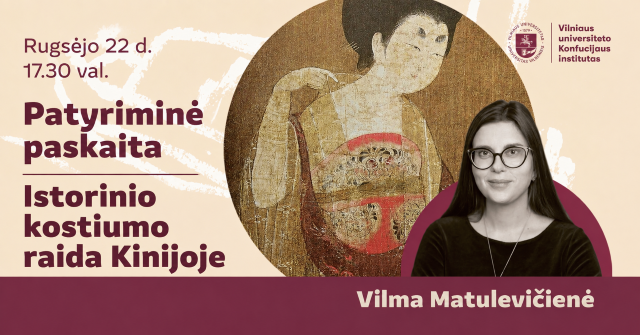
During the event, Vilma Matulevičienė, Director of the Confucius Institute and a sinologist, took participants on a journey through Chinese history, exploring how traditional Chinese clothing evolved alongside changes in dynasties, political circumstances, social values, and aesthetic ideals.
The lecture traced the evolution of Chinese costume from the Warring States period to the final imperial dynasties and the Republic of China. Participants learned about the significance of clothing in expressing social status, ritual traditions, and political authority, as well as how garment shapes, colours, and decorative elements reflected the worldviews and ideals of beauty of different historical periods.
Particular attention was given to the distinctive clothing styles of various dynasties: the loose, gracefully flowing silhouettes of early dynastic garments; the cosmopolitan fashion of the Tang dynasty, which embraced influences from Central Asia; the more restrained aesthetics of the Song dynasty; and the luxurious silks of the Ming dynasty. The lecture also explored the symbolism of imperial attire, dragon embroidery, the significance of colours, and the strict dress codes through which a person's social rank or position in society could be identified.
The lecture demonstrated that in China, costume was far more than simply clothing – it reflected political structures, philosophical ideas, social hierarchies, and evolving ideals of beauty.
In the second, hands-on part of the event, participants had the opportunity to examine historical costume reconstructions from the Han, Tang, Song, Ming, and Qing dynasties, as well as the Republican period. Some of the costumes could also be tried on, allowing participants not only to gain a deeper understanding of the clothing traditions of different eras but also to immerse themselves in the spirit of these historical periods.